Article author: Alwyn Ash
"At the right time, in the right light, everything is extraordinary"

"There is unrest in the Galactic Senate. Several thousand solar systems have declared their intentions to leave the Republic."
It has been ten years since the battle on Naboo, and yet there is still much to discover regarding the Sith and its plans. Following a failed assassination attempt on the life of Padmé Amidala (former Queen of Naboo and now a Senator of the Republic), Jedi Knight Obi-Wan Kenobi and his Padawan Anakin Skywalker are assigned to protect her. It is during a second attempt that they chase after a female shapeshifter assassin named Zam Wesell (Google is a wondrous creature) through the city, finally confronting her; she is, however, quickly silenced by her accomplice, a bounty hunter later to be revealed as Jango Fett (portrayed by New Zealand actor Temuera Morrison), who fires a toxic dart before fleeing the scene. Meanwhile, there is much unrest as war threatens to take hold of a galaxy so close to the brink...
What began with "The Phantom Menace", in 1999, George Lucas' extended vision has been in danger of tarnishing what had preceded it all those many years ago. For fans who lived through the original trilogy, this new installment was far from what had been expected. If Episodes IV-VI gave us adventure, and hope, then "Episode I" (Phantom Menace) tore through the very fabric with politics and conspiracies, a formula that neatly repeated itself in the second chapter of this prequel trilogy. I will, however, let you into a little secret - after fresh viewing, I am now prepared to look favourably upon Lucas' prequel trilogy. Perhaps the passing of time has made it easier to relive the films without anger or frustration; an awkward acceptance, if you will. But, in truth, there really are some good moments in "Attack of The Clones" that make worthy contributions to the Star Wars Universe.
Getting this out of the way early, it is still a major gripe that the over-used CGI regarding battle scenes and alien lifeforms should have been religiously employed by Lucas - far too much feels artificial and digitally contaminated. That said, the world of Naboo is beautifully recreated and realised, as Padmé and Anakin's relationship develops; it is just a shame that actor Hayden Christensen (who was still a better choice for the role than young Jake Lloyd, from the previous film) doesn't rise up to the occasion (so to speak) during what could have been some truly heartfelt scenes.
I will say this for Lucas, when he does get it right there can be no doubt of his creative talent. Obi-Wan's arrival on Kamino, for example, is a wonderful moment. An ocean planet, Kamino conceals a secret: an army of clone troopers being grown and trained for the Republic. The tall Kaminoans are a sight to behold, and have to be one of the most magnificent CGI creations in the film series. Even the Jedi Knight's first encounter with Jango and a very young Boba Fett in their room in Tipoca City on Kamino works well, later resulting in a fight sequence between Obi-Wan and the bounty hunter on a landing platform, only to follow on into an exciting space sequence as Jango attempts to destroy the Jedi and his ship after the latter planted a homing beacon to the outer hull of Jango's craft.
If Christensen does manage to steal any part of this installment then the death of Anakin's mother, Shmi Lars (née Skywalker), and the resulting execution of the Tusken Raiders ("Sand People") who held her captive and tortured her, truly demonstrates that the actor wasn't entirely miscast. With a vengeful look in his eyes, opening his soul to the dark side for the first time, Anakin raises his lightsaber and cuts them down, slaughtering the tribe, women and children. It is this loss of a parent that will ultimately send him on a path to seek the power to prevent death. For now, he mourns for the woman he loved but could not save: his mother. It may have been a brief role for Swedish actress and screenwriter Pernilla August (reprising the role from Chapter I), but Shmi's final moments are played beautifully.
The final act of "Attack of The Clones" certainly makes up for some of the earlier slower pieces, as Obi-Wan (Ewan McGregor's excellent portrayal of this maturing Jedi should be applauded), Anakin and Padmé fight for their lives in an arena against grotesque monsters. They triumph, but face an execution squad of droideka (battle droids). This is when an appearance by various Jedi Knights leads to one of the most impressive lightsaber battles in Star Wars history. It is breathtaking, a visual feast of action and well-structured choreography. Even actor Samuel L. Jackson as Jedi Master Mace Windu gets to join in. By comparison, the lightsaber duel between Yoda (voiced by Frank Oz) and Count Dooku (Christopher Lee) is a little bland and stilted, including the "Force lightening" and object manipulation scene as the Sith Lord tries to crush his opponent. Perhaps this is as a result of there being an actor verses CGI character, opposed to the powerfully realised duel between Luke Skywalker and Darth Vader in "Return of the Jedi". It should be noted that Vader's similar moment in "The Empire Strike Back", use of the Force to manipulate matter in a sequence against Luke in Cloud City, holds much more skill of direction, emotion and drama, however.
So, to the end. And the sight of a Clone army, preparing for battle... The final scene falls on Anakin and Padmé, in a nod to the closing seconds from "The Empire Strikes Back". It gives hope for a third chapter, as something dark approaches. A war. And, just as in the original trilogy, nothing will ever be the same again. As a fan, I can now put to rest one ghost: though deeply troubled, "Attack of The Clones" does at least manage to impress far more than "Phantom Menace" ever could, both in story and set pieces. There are glimpses of the original trilogy style in the mix, though more would have been better.
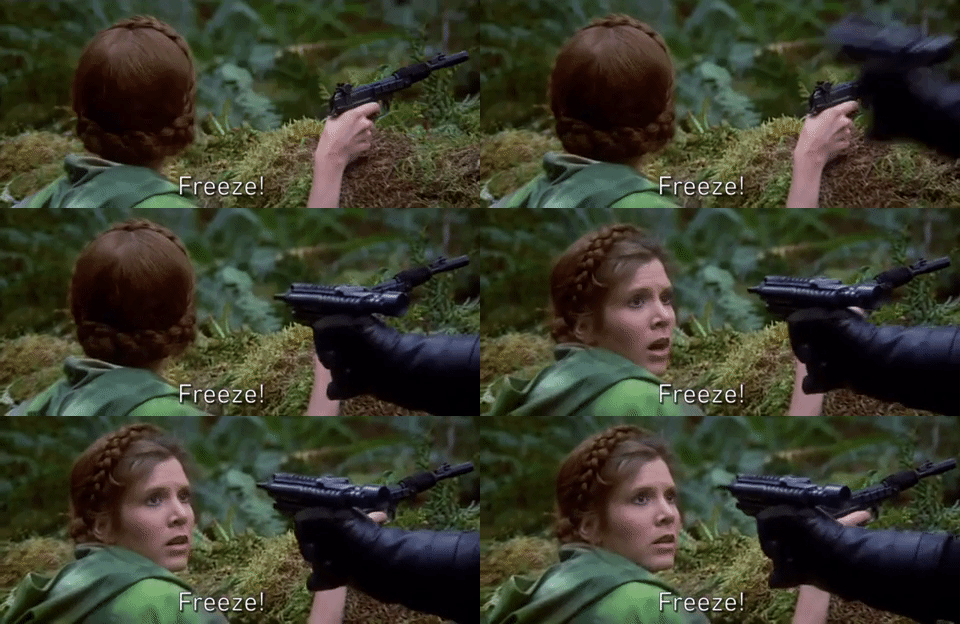
Final thought on actress Natalie Portman. Padmé Amidala is clearly no Leia Organa. They share a determination, but the latter reveals a fiery nature, stubborn and easily frustrated. By comparison, Padmé is patient, a romantic with ideals. Portman's performance works well considering the shortage of great dialogue or direction. Sadly however, Padmé serves to be a less memorable character than Leia. That said, I do like her. And was that actress Rose Byrne (Insidious) in a brief scene as handmaiden to Padmé in this feature?
"Attack of the Clones" certainly has its problems: one example, C3PO is suddenly a rather too flexible-looking CGI in one of the factory scenes on the planet Geonosis, making him look like a computer game character rather than something in a big budget motion picture - a major problem with much of Lucas' prequels. And please don't get me started on Anakin and Padmé's assembly line shenanigans! Still, there is much to be thankful for, and revenge is just around the corner, as "Episode III" waits to work its magic. Or does it?
Image source courtesy of lucasfilm.com. Article © Alwyn Ash 2015.
Quotes (if applicable) used for publicity purposes only; no infringement of copyright is intended.