Wednesday, April 15, 2020

Coronavirus (COVID-19) - Empty World


Hello, my name is Alwyn Ash, and Today I Am Facing An Unknown Future


This is an article I never thought would be written in my lifetime. It's a reflection of life in 2020. It's been reported that the first official case of COVID-19 can be traced to 17 November 2019, though the outbreak was officially announced in December 2019, known to have originated in Wuhan, Hubei, China. Most astonishingly of all is that the Chinese government allegedly tried to cover up the outbreak in the early days. Over four months later and the whole planet is in lockdown. In March 2020, the virus was recognised as a pandemic by the World Health Organization (WHO).

It's the most frightening time in my life so far. Though we've been told to remain indoors and isolate from this threat, it's become necessary to step outside and visit the local grocery store, or collect prescribed medication from a pharmacy. None of us were prepared for the situation we now find ourselves in. Which is weird, considering that novelists and movie directors have been warning us of such a scenario for decades. I'm immediately reminded of The Omega Man (1971), based on Richard Matheson's 1954 novel I Am Legend. Of course, there is a huge difference right now between our world and the one Charlton Heston's character, Neville, lives in. But there is no denying that we've all taken so much for granted.

Call me naive, but I always believed world governments could handle something as significant as a pandemic, that there would be in place specialised teams with enough equipment and knowledge to fight such a problem. Perhaps, at some undisclosed location, there existed a facility that held isolation rooms, a laboratory, whole areas where those infected could be transferred to under strict quarantine. Yes, thousands if need be! Travel between countries would be banned and Martial Law would come into operation, military aiding police in implementing a lockdown throughout the country and distributing supplies to civilians to prevent stock-piling. Alas, we're a long way from being organised. I would rather be in safe hands and guided by leaders that had planned for such an outcome than where we are at present, with uncertainty regarding food shortages and social distancing. One voice, one plan.

Okay, the idea of Martial Law isn't everyone's cup of tea, I completely understand. And that's perfectly fine. We all have opinions on the best ways of handling any given situation.

The reality: a British government that has reacted slowly; a society that panic-buys, leaving supermarket shelves bare; individuals who refuse to self-isolate either because they fail to realise the full potential of this pandemic or they just don't care, believing they're too young and healthy to die from it; and people who are unable to stay in their homes as directed at no fault of their own. The homeless are an issue, too, the vulnerable who have no where safe to quarantine.

Everything is chaos.

While a minority of the rich are complaining about being locked in their mansions, key workers at ground level are risking their lives by being on the front line to help others: grocery staff, medics, delivery drivers, care assistants, and many more who cannot just switch off and stay at home.


History Today - A Great Plague Is Upon Us


I was always fascinated and saddened by The Great Plague, which lasted for the period of 1665 to 1666. The bubonic plague killed without discrimination. First reports were of isolated cases in London, first appearing in the dock areas of the city, and in St. Giles parish. These early deaths were not reported as plague related and so no official quarantine measures were set in place. Though weekly deaths had increased in their hundreds, only a handful were recorded as plague. Finally household quarantine was ordered, with suspected plague victims to be shut up in their homes. Astonishingly, people in St. Giles reacted violently to this and a riot ensued, resulting in the first house that had been sealed to be opened up and its inhabitants released. This led to the construction of isolation hospitals known as pest-houses. Over the months there were more cases, and deaths.

The plague was rampant in London by July 1665. Those rich enough fled, including sovereign of that time: King Charles II of England! But for most it was a terrifying time, unable to escape infection and the infected. Businesses shut down. Though some of the poor did manage to leave the city, on evidence of good health by producing a certificate signed by the Lord Mayor, it was not easy - many were turned back by outer villages and some died of thirst or hunger during the hot Summer. By this point it was believed that just over 2,000 residents had died from plague in London. Pits were dug for those that had died. Dead-carts were driven through streets carrying piles of bodies. At one point there were so many victims and so few cart drivers that corpses were stacking up in their homes.

Feels strange typing this as I look out of my own window to see an empty street. Today businesses are mostly closed also, only those classed as essential still open their doors, though the number of customers at any one time has been restricted. Like those stuck in London in 1665, my family is unable to go someplace safe - we have no access to a country retreat. I'm forced to walk those streets for whatever food supplies I can find in local stores, and though I've ordered my mother's prescription online a text has arrived stating that I now have to walk to another store on the other side of town to collect them.

So I must stay safe, keep a distance from others and thoroughly wash my hands upon returning home. I'm a carer, my mother is of pension age and has recently been in hospital. She is one of those vulnerable from Coronavirus. Yes, I'm scared for her safety. What if I become sick, and am unable to look after her?


History Will Judge Us


Future historians will have unlimited access to this century, they'll write essays and present documentaries, schools will learn of 2020 and gravestones will carry the scars. I'm part of this "history", and I just don't know where it will lead. I'd rather die of old age in another 40 years time than be a statistic for COVID-19.

I feel the weight of responsibility for keeping both myself and my mother safe. Because right now I'm the only person that could potentially give it to her. She can't go out. Not enough has been done to protect our daily lives, and there is just not enough support networks in place. Not everyone is observing social distancing and maintaining the 2 metre distance advised by government, either. My local Tesco Express store isn't limiting the number of customers at any one time, so we're still passing each other too close and trying to get past staff who are stocking shelves. No, I don't blame the staff at all, they are heroes and life wouldn't function without them. They clearly are in need of better management and organisation. It doesn't help that companies are doing their own thing and that there isn't a single set of regulations governed by law. Yes, this pandemic is unprecedented, but we've always known it to be on the cards.


Empty world


In 1977, an apocalyptic novel written by John Christopher was published. Empty World tells the story of a disease called the Calcutta Plague, which accelerates the ageing process in all human beings. It is told from the point of view of 15-year-old Neil Miller, who at one stage contracts the virus but ultimately survives after a fever. Eventually those of all ages can succumb to the plague, leaving handfuls of survivors. I first read it over ten years ago and in recent years have bought a fresh copy from Aladdin Books, an imprint owned by Simon & Schuster.

Ironically, there have been reports of a surge in apocalyptic movies being streamed during this modern-day pandemic. Maybe it's a form of self-counselling, to remind some of us that no matter what the world throws at us, it could be a lot worse? Or they're looking to these films for inspiration, as a survival guide? Personally, I have been studying the history of television shows such as 1970s British series Survivors, which originally aired from 1975-77. It tells the story of a plague called "The Death" that goes global, decimating the population. The BBC (British Broadcasting Corporation) ran a version in 2008, lasting for two seasons. And in 2014, Big Finish (a company that specialises in audio drama) began releasing a number of boxsets featuring new stories set in the world of Survivors.

I am yet to hear any of these or watch either television series. Whether now is the right time, I'm not so sure.

The 2020 pandemic is destroying lives, robbing families of loved ones, and crippling businesses and the world economy. There is deep uncertainty. It's heartbreaking to witness these events. What will come in the next six months is anyone's guess, because history is still being written. But what I do know is that life must change as a result of this, attitudes towards others need to be reevaluated. Everyone is playing their part. Without artists there would be no books, artwork, movies or audiobooks to keep us entertained during the isolation period; without key workers there would be no access to mail, food, money or other vital products; and where would this world be without doctors, nurses and care workers? there are others, too, without whom our present predicament would be much darker and far scarier.

I have learned something about myself: there is an inner strength. I'm far from perfect, and I have had terrible days of feeling desperation and crying, but the strength helps to pick me back up and fight again, determined to protect loved ones from harm. I am learning to appreciate what really matters.

Everything else is just a luxury.


Tuesday, May 26, 2015

FilmLight - The Tripods: Where is John Christopher's movie series now?


Article author: Alwyn Ash
"At the right time, in the right light, everything is extraordinary"


Tripods Image


Isn't it just frustrating when news of a movie based on a popular series of novels seemingly dies out and no one, not one single person, knows why?

For years there had been rumours of a transition from book to screen for 1967 novel The Tripods: The White Mountains, written by John Christopher (pseudonym for Samuel Youd). Only as far back as 2009 several websites had reported that Australian filmmaker Alex Proyas (The Crow, Dark City, I, Robot) was linked to a possible adaptation. It had been suggested that the character of Beanpole would be a girl, and that the Tripod machines themselves could climb the Eiffel Tower.

So was Proyas really serious about working with writer Stuart Hazeldine on the film project? Were the reports even true? Just where are the updates now?

Of course, there had once been a televised version of The Tripods, jointly produced by the BBC in the United Kingdom and the Seven Network in Australia, with music supplied by Ken Freeman. It was to be a landmark in special effects design and superb model work. However, even this failed to keep the flame burning: the first two books - The White Mountains and The City of Gold and Lead (the latter originally published in 1968) - were transferred to our television screens; the third instalment, sadly, never made it, due to a rather ridiculous decision to cancel the show following end of filming of the second series, which concluded with those famous last words spoke by young Will Parker after discovering the hideout of the uncapped to be in ruin, "Has it all been for nothing?"

And so fans were left with a cliffhanger that would never be resolved - at least, not on screen.

It was certainly a plus that the original books were republished by Puffin Books in 1984 thanks to the television series (individually and as a single paperback trilogy), and with the reprinting of The Tripods: The Pool of Fire (also originally published in 1968) viewers finally got to read the final part of the trilogy to discover the fate of the three lead antagonists: Will, Henry and Beanpole.

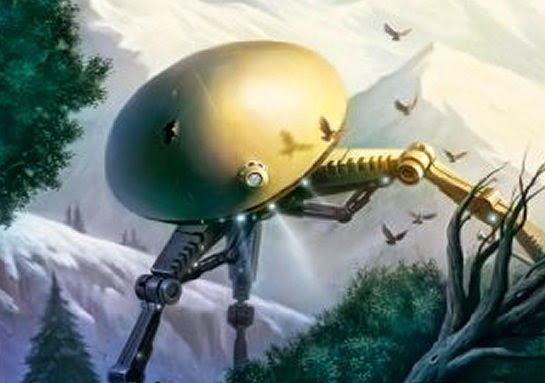
If you don't know anything about the trilogy, let me explain: the Tripods were vast three-legged machines that controlled the minds of the adult human population by way of a Cap fitted to the skull to suppress emotion, creativity and curiosity. At the age of fourteen you are Capped, to become a man, or young woman. Will (played by actor John Shackley in the BBC production) encounters a Vagrant, Ozymandias - from this point on the teenager is curious about the Tripods, and is told of free men living far away, those who refuse to be subservient to the mysterious creatures that rule the world. Joined by his cousin Henry, and later Beanpole (a French boy whose real name is Jean-Paul), Will ventures into unfamiliar territory on a quest to locate the White Mountains, where these free people dwell. Though quite clearly a story for a young audience, The Tripods is gripping and exciting, and paved the way for a prequel novel: When the Tripods Came (1988), to feature new characters during the early days of invasion.

So what about the movie? Considering the quality of the original story, a trilogy series would be highly successful - think The Lord of The Rings except with a sci-fi rather than a fantasy element!

There is no doubt that John Christopher's Tripod legacy will be adapted, at some point. And when it does, how will it compare to the original novels? Will Beanpole really be a girl? In an interview with horror website Dread Central, in 2010, writer Hazeldine commented, "Tripods… again, we’re trying to find a studio home for that. We developed that at Paramount and it was put into turnaround. It was originally developed at Disney through many different writers and many different directors. I’d been offered it twice when it was based at Disney, but both times I just couldn’t do it. I’d always really wanted to do it because I adored Tripods as a kid. I read all of the books, watched the BBC show, and I loved it. I used to go sit on the North Downs in Surrey and look out across the English countryside and imagine Tripods walking across the horizon, you know?"

His comment that "We’ve been close a couple of times in the last few months, but we’re still trying to find a studio to do it" should bring hope, though as the years pass, still no sign of those colossal Tripods striding with menace through Mankind's hopes and dreams...

I should also mention, perfect timing, that another of the prolific author's books landed on my doorstep a while back: Empty World. Originally published in 1977, the story focuses on a disease, called the Calcutta Plague (any guesses as to why it is so called?), that inflicts an ageing acceleration on its victims thus killing them. "World" takes a look at life during and after the event, as survivor Neil Miller (a fifteen year old boy) attempts to come to terms with the changing world around him, and the loss that he encounters along the way.

It is good to know that many of John Christipher's works are being republished for a newer audience, including The Tripods, by Simon & Schuster's imprint label Aladdin, though I'm sure older fans will enjoy collecting fresher copies for their bookshelves! Empty World, in particular, is as relevant today as it was when first published, what with the continuing threat of global terrorism, Swine influenza etc.

As for Sam Youd, who passed away in February 2012, thank you for all that you have done - happy memories are the photographs in which we revisit from time to time; and my photograph album is all the richer for the work you have shared.

Further reading: The Guardian Obituary


Image source courtesy of bbc.co.uk/cult/classic/tripods. Article © Alwyn Ash 2015.
Quotes (if applicable) used for publicity purposes only; no infringement of copyright is intended.

Thursday, May 16, 2013

When Worlds Collide: Alien Invasion...

Article author: Alwyn Ash


Earth Vs the flying saucers is nothing new, and in some cases there aren’t even any flying saucers to contend with. In 1898 H.G. Wells published The War of the Worlds, setting a blueprint for what was to follow in the Universe of book, film and television. Here is a list of some of those…


The War of the Worlds

And so I begin with this classic tale of Martians and their attempts to colonise Earth. If any alien invasion were to be considered the father of all invasions then this would surely be it? Originally written from the point of view of an unnamed protagonist in the first-person narrative, we are given two parts: "Book One: The Coming of the Martians" and "Book Two: The Earth under the Martians". It would not be a spoiler to say that the Martians eventually succumb to microbial infections to which they have no immunity, and perish. Which is a relief quite simply, as Mankind makes no affect on preventing the colonisation otherwise.

Inspired by the novel came adaptations in comic, radio, film and television, a musical, and games. You may be aware of the popular film versions from 1953 (directed by Byron Haskin and starring Gene Barry as Dr. Clayton Forrester) and 2005 (directed by Steven Spielberg and starring Tom Cruise as Ray Ferrier), but did you know that a short-lived television series that ran for two seasons had been broadcast, incorporating ideas from the 1953 film, Orson Welles’ 1938 radio adaptation, and original novel?


The War of the Worlds, 1953 - a Martian war machine,
designed by Albert Nozaki (1912-2003)


According to the first series (airing 1988-89), the aliens (they are now revealed to have not originated from Mars at all but from a world 40 light years away) had not in fact died after their failed invasion but had fallen into a state of suspended animation. So move on some thirty-five years after the 1953 incident and these aliens are resurrected thanks to a group of terrorists – the bodies of these terrorists are later possessed, a vehicle that would become frequent through the series (hence the opening narration from Season One stating, “In 1953, the aliens started taking over the world; today, they're taking over our bodies”).

Season 2 (1989-90) was a somewhat different beast with new writers and a new team to guide it along. If only the plot strands in the previous season had been picked up, and developed further… Oh well. Moving on...

The highlight for me is Jeff Wayne’s Musical version of The War of the Worlds, a captivating and groundbreaking achievement of sound, storytelling and out of this world escapism. Originally told via an album, released to the world in 1978, the whole project was later turned into an equally effective and stunning stage musical, the first live show featuring such talents as Justin Hayward (who can forget the beautifully sung Forever Autumn?), Russell Watson, Alexis James and Tara Blaise. The stage play is also known for its use of a "virtual" Richard Burton as The Journalist.

There have been many other interpretations of H.G. Wells’ famous story but the book itself is highly recommended…


Doctor Who

One series refusing to let the Earth live out its remaining existence in peace is that which stars a Time Lord and his blue box, aka the TARDIS. First broadcast in 1963, the Doctor and his companions have faced dangers, historic events, and extra terrestrials. However, the first most memorable invasion (serial chronology) comes in Earth’s future, following a meteorite bombardment delivering plague. Failing to find a cure in time, the majority of the world dies. Those who survive face an altogether different threat – Daleks!

No matter how many battles are fought, lost or won, the children of Skaro never leave it too long before they are back, plotting new devilish schemes. And they are not alone… the Earth is a magnet for alien invaders, whether they are humanoid, energy beings or other. In a bid to protect Humankind from destruction, the Torchwood Institute was set up, in 1879. Other organisations to fight in the war to protect Earth include the Unified Intelligence Taskforce (formerly known as the United Nations Intelligence Taskforce) or, prior, the Intrusion Countermeasures Group (or ICMG). And there are plenty of cases for them to investigate.

Whatever the threat, there has always been one constant – the Doctor, a mysterious time and space traveller whose resolve has spared races from genocide, saved a family from losing its children, or liberated a species from enslavement. But, each and very time, this mysterious man is brought back to Earth, where he battles the might of a Cyber army, the deranged scheming of a fellow Time Lord intent on world domination, or a telepathic gestalt entity able to manipulate plastic. In each and every century, there is always the threat of annihilation for the Human species.

Furthermore, the adventures of Doctor Who have appeared in a wide variety of formats including novel, audiobook and comic, all expanding on Earth’s relationship with the Time Lord and giving us new invasions to face, fight, and overcome.

The quest to protect never ends…


V

They came in peace, willing to share their superior technology, medical and scientific knowledge; in return all they required were chemicals and minerals to help save their dying planet. Originally written and directed by Kenneth Johnson, "V: The Mini Series" (1983) became something more, a desperate attempt to save Mankind – and the Earth – from destruction.

Humanoid in appearance, "The Visitors" first appear in a fleet of saucer-shaped motherships. Militarism is predominant here as the new arrivals swiftly overcome our day-to-day lives, their shock troopers patrolling the streets; people mysteriously disappearing, scientists especially (some returning only to serve the will of these alien masters); propaganda designed to encourage loyalty, which also leads to a youth auxiliary movement called the Friends of the Visitors.

It isn’t long before we have Human collaborators informing on neighbours, friends and family, seduced by the power rewarded to them.


Original "Visitors": Jane Badler (Diana), Richard Herd (John),
Peter Nelson (Brian), and Andrew Prine (Steven)


Refusing to just lie down and surrender to the will of these invaders, a worldwide resistance movement is formed; the Los Angeles cell is led by Julie Parrish (portrayed by Faye Grant), a med student working as a research scientist at a local hospital.

There is no doubting that the revealing of The Visitors to be not human-like at all but grotesque carnivorous reptilian humanoids is the Ace card here, a true shock moment as TV journalist cameraman Michael Donovan secretly boards the LA Mother Ship and explores its secrets; a synthetic skin and contact lenses are used to shield their true form from the Human populace, as Donovan discovers to his horror.

A “Fifth Column” was also introduced to complement the series, renegade aliens sympathetic to the Human cause.

The general success of "V: The Mini Series" led to "V: The Final Battle" (1984) as the struggle between resistance and alien reached its satisfying conclusion. Or did it? "V: The Series" (1984-85) took what had gone before, presenting a new fleet of motherships and a fresh conflict. Just one season in, the TV series was cancelled, ending with a cliffhanger never to be resolved.

If fans needed to live out further resistance campaigns against the alien forces then there were a number of novels published by Pinnacle Paperbacks and Tor (US) and New English Library (UK).

There would, however, be a rebirth with the re-imagined series of the same name. "V" premiered on the ABC network in 2009 to positive reviews; a whole new cast was assembled portraying various characters different to those in the original. Season Two even saw the return of stars from the 1980’s version - Jane Badler and Marc Singer.

This series, too, was cancelled after its second season. A fan letter-writing campaign called Project Alice had been set up to save the show.


The Tripods

If H.G. Wells’ The War of the Worlds were to focus on three teenage boys as they journey in search of freedom, then John Christopher’s tale of Tripods and Capping would be the perfect fit. However, seeing as the “trilogy” focuses on life after an invasion, we shall take a look at the prequel novel published in 1988: "When The Tripods Came", written twenty years after the previous book.

Set in the late twentieth century, Christopher’s tale focuses on a young English boy called Laurie who, with his friend Andy, witnesses the arrival of the first Tripod, a cumbersome machine that swiftly kills a dog and demolishes a farmhouse. The alien tripod is quickly destroyed in response by fighter-bombers. At first this is seen as a “Close Encounter of the Absurd Kind”, but the “cosmic farce” is simply the prelude to an invasion.

A stealth attack comes via mind-control technology that hypnotises the audience of a new TV show called The Trippy Show – this campaign leads to those who are now affected, “Trippies”, eventually trying to convert others, using a helmet-like device to function as a receiver for the brainwashing.

As the world is engulfed by chaos, falling under Tripod control, Laurie and his family escape to Switzerland; the country has adopted an isolationist stance since the rising of a Trippy army in an attempt to hold off against possible invasion – any Trippies caught on its soil are immediately detained.

Invasion, however, is inevitable and the Swiss succumb to the will of the alien invaders, adopting the “Caps” that are eventually implanted, now permanent until the wearer’s death. With nowhere else to hide, Laurie and his companions (now joined by new members), flee into the Alps. It is here where they eventually establish a resistance movement that will lead to the first of the original trilogy, "The White Mountains" (1967).

Set in a future where Mankind has already become dominated by aliens, author Christopher (real name Samuel Youd) told the tale of village boy Will Parker who, intrigued by a Vagrant called Ozymandias, goes on a quest to locate the base of a resistance movement determined to rid the world of Tripod rule. Joined by his cousin Henry, and a French boy named Jean-Paul (nicknamed "Beanpole"), Will risks everything to escape Capping.

As the trilogy unfolds, "The City of Gold and Lead" (1968) sees Will and fellow resistance fighter Fritz Eger infiltrate the city of the Tripods in an attempt to bring back any information that may be useful in their fight against Mankind’s suppressors. The final novel in the series, "The Pool of Fire" (1968), focuses on spreading the movement further, gaining allies and the eventually attack on the three Tripod cities.

In a joint production with the Seven Network in Australia, the BBC broadcast an adaptation of the first two books in the trilogy. Sadly, although a script had been written, a third series was never filmed.


The Invaders

Created by Larry Cohen, sixties sci-fi series "The Invaders" focused on David Vincent (played by Roy Thinnes), an architect who accidentally uncovers an alien plot to invade Earth – and they are already here, making plans! Through two seasons he travels from place to place, focusing on undermining the alien plot whilst trying desperately to warn the public. There is one problem, however: the invaders can assume a human disguise, making it difficult to know who can be trusted.

Naturally, Vincent’s attempts to persuade the populace that beings from another world stalk the Earth are met with scepticism by most. Even the task of acquiring physical evidence is met with impossible odds: when dying, an alien’s body blazes red and disintegrates – anything he touches can also vaporise, which seems to be the duty of any alien if such a situation occurred: to eliminate technology and prevent it from falling into enemy hands. The alien invaders are armed with weaponry that much has equal effect, and they use it, too, to disintegrate witnesses, vehicles and anything else that is appropriate to further their campaign.

Though met with doubt by most, David Vincent does manage to gain believers, and a few allies, in his quest, including millionaire Edgar Scoville.

Though never resolved through two seasons, and cancelled in 1968, the series does make a return in 1995 as a remake miniseries starring Scott Bakula of Quantum Leap and Star Trek: Enterprise fame – Thinnes resurrecting his role briefly as Vincent.


Further reading: A shorter version of this article was originally published on Cultbox


Thursday, January 24, 2013

The Tripods Collection: The White Mountains - BookReview

"John Christopher is the pseudonym under which the British science fiction author Samuel Youd has been most successful."

Christopher Samuel Youd, under the pen-name John Christopher, wrote a trilogy in the sixties about machines that had taken over the Earth and brainwashed the human population; all except those under the age of 14 submitted to the “Cap”. Becoming a man, or woman, meant Capping Day, a great celebration and feast when one is truly overcome by the Tripods, freewill replaced by subservience.

For Will, a thirteen-year-old boy living in the small English village of Wherton, the day is approaching when he will become a man. But a brief encounter with a vagrant, Ozymandias, changes his destiny. Told of a land where free men live, far away from the hold of the Tripods, Will decides to leave his home and travel. It would be a lonely journey except… he is accompanied by Henry, his cousin, an annoying bully who Will dislikes immensely. And so the first story in the series, The Tripods: The White Mountains, begins.

To be unfamiliar with The War of The Worlds, a novel by author H. G. Wells, means you have spent your entire life in a parallel universe where books simply do not exist. So I will not explain the plot or detail its origins. I will, however, tell you that both The War of The Worlds and The Tripods have something in common: vast metal machines dominating the landscape; alien beings who wish to colonize the Earth. It is reasonable to suggest that John Christopher was deeply inspired by H. G. Wells’ work, expanding the plot to incorporate his lead characters and to give us a better understanding of a world dominated by alien superpower.


The White Mountains


And so Will and Henry, determined to free themselves of Tripod rule, journey overseas to France, where they meet new companion Zhan-pole, a bespectacled boy of intellect and curiosity. Upon hearing Zhan-pole’s name, Henry jokes: “More like Beanpole!” and so the nickname sticks throughout the trilogy as two now becomes three. Their adventures are not without problems however; every step they tread must be carefully chosen, or risk being noticed by those who serve their Masters, for the boys would undoubtedly be arrested and Capped.

Written in first-person narrative (like The War of The Worlds), we share Will’s experiences and feelings, making the story far more personal. I always prefer this approach, it draws you in deeper and helps you to understand the true uncertainty of their predicament. This is one for the young adult (and older) as it deals with relationships, friendships, and loss. Christopher carefully crafts this to precision, cleverly broadening the lives of these three young men only to bring it crashing down around them.

There is also conflict: Will’s feelings for Eloise, daughter of the Comte and Comtesse de la Tour Rouge, become so great that he is willing to sacrifice all – freedom included – to share happiness with this beautiful girl. It is a decision that angers his cousin and the two fight. Eventually, however, the decision to remain with Eloise is taken from him: during a tournament she is selected as Queen of the event, an honor that requires serving the Tripods in their city. Will is heartbroken. Leaving the Château de la Tour Rouge, he continues his journey in search of the White Mountains, where free men dwell. Thankfully, he is soon reunited with his two friends, Henry and Beanpole, and their quest nears its end.

Although it deals with many elements, it is friendship that remains the true message here. It is quite clear that Will, Henry and Beanpole need each other, and the trust that develops between them bonds them in a way that the Cap never could – being Capped means abandoning loyalty and genuine friendship, instead getting along together simply because the Tripods wish it. Empty harmony. What is the point in being harmonious if you don’t have the free will to enjoy it? What these three boys share is special, and real…

Though now out of print, but still attainable from various online sources, The Tripods: The White Mountains is highly recommended! Exciting adventure yarn that slowly but surely lures you into a world of danger, suspicion, and excitement. There is enough to keep both young and older fans happy as the journey of Will and his friends unfolds.


Purchase Tripods from the Starfoyer Enterprise Store:
DVD Books - Running time: 625 minutes