Article author: Alwyn Ash
Earth Vs the flying saucers is nothing new, and in some cases there aren’t even any flying saucers to contend with. In 1898 H.G. Wells published The War of the Worlds, setting a blueprint for what was to follow in the Universe of book, film and television. Here is a list of some of those…
The War of the Worlds
And so I begin with this classic tale of Martians and their attempts to colonise Earth. If any alien invasion were to be considered the father of all invasions then this would surely be it? Originally written from the point of view of an unnamed protagonist in the first-person narrative, we are given two parts: "Book One: The Coming of the Martians" and "Book Two: The Earth under the Martians". It would not be a spoiler to say that the Martians eventually succumb to microbial infections to which they have no immunity, and perish. Which is a relief quite simply, as Mankind makes no affect on preventing the colonisation otherwise.
Inspired by the novel came adaptations in comic, radio, film and television, a musical, and games. You may be aware of the popular film versions from 1953 (directed by Byron Haskin and starring Gene Barry as Dr. Clayton Forrester) and 2005 (directed by Steven Spielberg and starring Tom Cruise as Ray Ferrier), but did you know that a short-lived television series that ran for two seasons had been broadcast, incorporating ideas from the 1953 film, Orson Welles’ 1938 radio adaptation, and original novel?

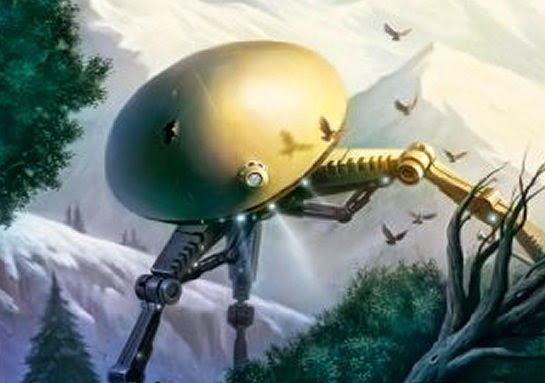
The War of the Worlds, 1953 - a Martian war machine,
designed by Albert Nozaki (1912-2003)
According to the first series (airing 1988-89), the aliens (they are now revealed to have not originated from Mars at all but from a world 40 light years away) had not in fact died after their failed invasion but had fallen into a state of suspended animation. So move on some thirty-five years after the 1953 incident and these aliens are resurrected thanks to a group of terrorists – the bodies of these terrorists are later possessed, a vehicle that would become frequent through the series (hence the opening narration from Season One stating, “In 1953, the aliens started taking over the world; today, they're taking over our bodies”).
Season 2 (1989-90) was a somewhat different beast with new writers and a new team to guide it along. If only the plot strands in the previous season had been picked up, and developed further… Oh well. Moving on...
The highlight for me is Jeff Wayne’s Musical version of The War of the Worlds, a captivating and groundbreaking achievement of sound, storytelling and out of this world escapism. Originally told via an album, released to the world in 1978, the whole project was later turned into an equally effective and stunning stage musical, the first live show featuring such talents as Justin Hayward (who can forget the beautifully sung Forever Autumn?), Russell Watson, Alexis James and Tara Blaise. The stage play is also known for its use of a "virtual" Richard Burton as The Journalist.
There have been many other interpretations of H.G. Wells’ famous story but the book itself is highly recommended…
Doctor Who
One series refusing to let the Earth live out its remaining existence in peace is that which stars a Time Lord and his blue box, aka the TARDIS. First broadcast in 1963, the Doctor and his companions have faced dangers, historic events, and extra terrestrials. However, the first most memorable invasion (serial chronology) comes in Earth’s future, following a meteorite bombardment delivering plague. Failing to find a cure in time, the majority of the world dies. Those who survive face an altogether different threat – Daleks!
No matter how many battles are fought, lost or won, the children of Skaro never leave it too long before they are back, plotting new devilish schemes. And they are not alone… the Earth is a magnet for alien invaders, whether they are humanoid, energy beings or other. In a bid to protect Humankind from destruction, the Torchwood Institute was set up, in 1879. Other organisations to fight in the war to protect Earth include the Unified Intelligence Taskforce (formerly known as the United Nations Intelligence Taskforce) or, prior, the Intrusion Countermeasures Group (or ICMG). And there are plenty of cases for them to investigate.
Whatever the threat, there has always been one constant – the Doctor, a mysterious time and space traveller whose resolve has spared races from genocide, saved a family from losing its children, or liberated a species from enslavement. But, each and very time, this mysterious man is brought back to Earth, where he battles the might of a Cyber army, the deranged scheming of a fellow Time Lord intent on world domination, or a telepathic gestalt entity able to manipulate plastic. In each and every century, there is always the threat of annihilation for the Human species.
Furthermore, the adventures of Doctor Who have appeared in a wide variety of formats including novel, audiobook and comic, all expanding on Earth’s relationship with the Time Lord and giving us new invasions to face, fight, and overcome.
The quest to protect never ends…
V
They came in peace, willing to share their superior technology, medical and scientific knowledge; in return all they required were chemicals and minerals to help save their dying planet. Originally written and directed by Kenneth Johnson, "V: The Mini Series" (1983) became something more, a desperate attempt to save Mankind – and the Earth – from destruction.
Humanoid in appearance, "The Visitors" first appear in a fleet of saucer-shaped motherships. Militarism is predominant here as the new arrivals swiftly overcome our day-to-day lives, their shock troopers patrolling the streets; people mysteriously disappearing, scientists especially (some returning only to serve the will of these alien masters); propaganda designed to encourage loyalty, which also leads to a youth auxiliary movement called the Friends of the Visitors.
It isn’t long before we have Human collaborators informing on neighbours, friends and family, seduced by the power rewarded to them.

Original "Visitors": Jane Badler (Diana), Richard Herd (John),
Peter Nelson (Brian), and Andrew Prine (Steven)
Refusing to just lie down and surrender to the will of these invaders, a worldwide resistance movement is formed; the Los Angeles cell is led by Julie Parrish (portrayed by Faye Grant), a med student working as a research scientist at a local hospital.
There is no doubting that the revealing of The Visitors to be not human-like at all but grotesque carnivorous reptilian humanoids is the Ace card here, a true shock moment as TV journalist cameraman Michael Donovan secretly boards the LA Mother Ship and explores its secrets; a synthetic skin and contact lenses are used to shield their true form from the Human populace, as Donovan discovers to his horror.
A “Fifth Column” was also introduced to complement the series, renegade aliens sympathetic to the Human cause.
The general success of "V: The Mini Series" led to "V: The Final Battle" (1984) as the struggle between resistance and alien reached its satisfying conclusion. Or did it? "V: The Series" (1984-85) took what had gone before, presenting a new fleet of motherships and a fresh conflict. Just one season in, the TV series was cancelled, ending with a cliffhanger never to be resolved.
If fans needed to live out further resistance campaigns against the alien forces then there were a number of novels published by Pinnacle Paperbacks and Tor (US) and New English Library (UK).
There would, however, be a rebirth with the re-imagined series of the same name. "V" premiered on the ABC network in 2009 to positive reviews; a whole new cast was assembled portraying various characters different to those in the original. Season Two even saw the return of stars from the 1980’s version - Jane Badler and Marc Singer.
This series, too, was cancelled after its second season. A fan letter-writing campaign called Project Alice had been set up to save the show.
The Tripods
If H.G. Wells’ The War of the Worlds were to focus on three teenage boys as they journey in search of freedom, then John Christopher’s tale of Tripods and Capping would be the perfect fit. However, seeing as the “trilogy” focuses on life after an invasion, we shall take a look at the prequel novel published in 1988: "When The Tripods Came", written twenty years after the previous book.
Set in the late twentieth century, Christopher’s tale focuses on a young English boy called Laurie who, with his friend Andy, witnesses the arrival of the first Tripod, a cumbersome machine that swiftly kills a dog and demolishes a farmhouse. The alien tripod is quickly destroyed in response by fighter-bombers. At first this is seen as a “Close Encounter of the Absurd Kind”, but the “cosmic farce” is simply the prelude to an invasion.
A stealth attack comes via mind-control technology that hypnotises the audience of a new TV show called The Trippy Show – this campaign leads to those who are now affected, “Trippies”, eventually trying to convert others, using a helmet-like device to function as a receiver for the brainwashing.
As the world is engulfed by chaos, falling under Tripod control, Laurie and his family escape to Switzerland; the country has adopted an isolationist stance since the rising of a Trippy army in an attempt to hold off against possible invasion – any Trippies caught on its soil are immediately detained.
Invasion, however, is inevitable and the Swiss succumb to the will of the alien invaders, adopting the “Caps” that are eventually implanted, now permanent until the wearer’s death. With nowhere else to hide, Laurie and his companions (now joined by new members), flee into the Alps. It is here where they eventually establish a resistance movement that will lead to the first of the original trilogy, "The White Mountains" (1967).
Set in a future where Mankind has already become dominated by aliens, author Christopher (real name Samuel Youd) told the tale of village boy Will Parker who, intrigued by a Vagrant called Ozymandias, goes on a quest to locate the base of a resistance movement determined to rid the world of Tripod rule. Joined by his cousin Henry, and a French boy named Jean-Paul (nicknamed "Beanpole"), Will risks everything to escape Capping.
As the trilogy unfolds, "The City of Gold and Lead" (1968) sees Will and fellow resistance fighter Fritz Eger infiltrate the city of the Tripods in an attempt to bring back any information that may be useful in their fight against Mankind’s suppressors. The final novel in the series, "The Pool of Fire" (1968), focuses on spreading the movement further, gaining allies and the eventually attack on the three Tripod cities.
In a joint production with the Seven Network in Australia, the BBC broadcast an adaptation of the first two books in the trilogy. Sadly, although a script had been written, a third series was never filmed.
The Invaders
Created by Larry Cohen, sixties sci-fi series "The Invaders" focused on David Vincent (played by Roy Thinnes), an architect who accidentally uncovers an alien plot to invade Earth – and they are already here, making plans! Through two seasons he travels from place to place, focusing on undermining the alien plot whilst trying desperately to warn the public. There is one problem, however: the invaders can assume a human disguise, making it difficult to know who can be trusted.
Naturally, Vincent’s attempts to persuade the populace that beings from another world stalk the Earth are met with scepticism by most. Even the task of acquiring physical evidence is met with impossible odds: when dying, an alien’s body blazes red and disintegrates – anything he touches can also vaporise, which seems to be the duty of any alien if such a situation occurred: to eliminate technology and prevent it from falling into enemy hands. The alien invaders are armed with weaponry that much has equal effect, and they use it, too, to disintegrate witnesses, vehicles and anything else that is appropriate to further their campaign.
Though met with doubt by most, David Vincent does manage to gain believers, and a few allies, in his quest, including millionaire Edgar Scoville.
Though never resolved through two seasons, and cancelled in 1968, the series does make a return in 1995 as a remake miniseries starring Scott Bakula of Quantum Leap and Star Trek: Enterprise fame – Thinnes resurrecting his role briefly as Vincent.
Further reading: A shorter version of this article was originally
published on Cultbox